PSIR Optional Syllabus —standing for Political Science and International Relations—is one of the most popular optional subjects for the UPSC Civil Services Examination. It is a subject that not only helps you understand political systems and international relations but also aligns well with the General Studies papers, making it a strategic choice for many candidates. Opting for this paper offers significant advantages; furthermore, since the competition in this subject is relatively lower, it is a choice you should definitely consider.
In this article, we will cover everything you need to know regarding the PSIR optional subject—including its syllabus, recommended books, study notes, previous years’ question papers (PYQs), toppers’ strategies, and much more. Whether you are just starting out or looking to refine your preparation, this guide will help you navigate this subject with ease.
Why Choose PSIR Optional Syllabus?
Here are some reasons why PSIR is a great choice as an optional subject for the UPSC exam:
- Overlap with General Studies: PSIR overlaps with GS-II (Polity, Governance, and International Relations) and GS-III (Internal Security). This means that preparing for PSIR can also help you score well in the GS papers.
- Scoring Subject: PSIR is considered a scoring subject because the answers can be structured well, and the questions are often straightforward.
- Interest and Relevance: If you are interested in politics, governance, and international affairs, PSIR will keep you engaged. It is also highly relevant to the work of an IAS officer.
- Availability of Resources: There are plenty of resources available for PSIR, including books, notes, and topper copies, making it easier to prepare
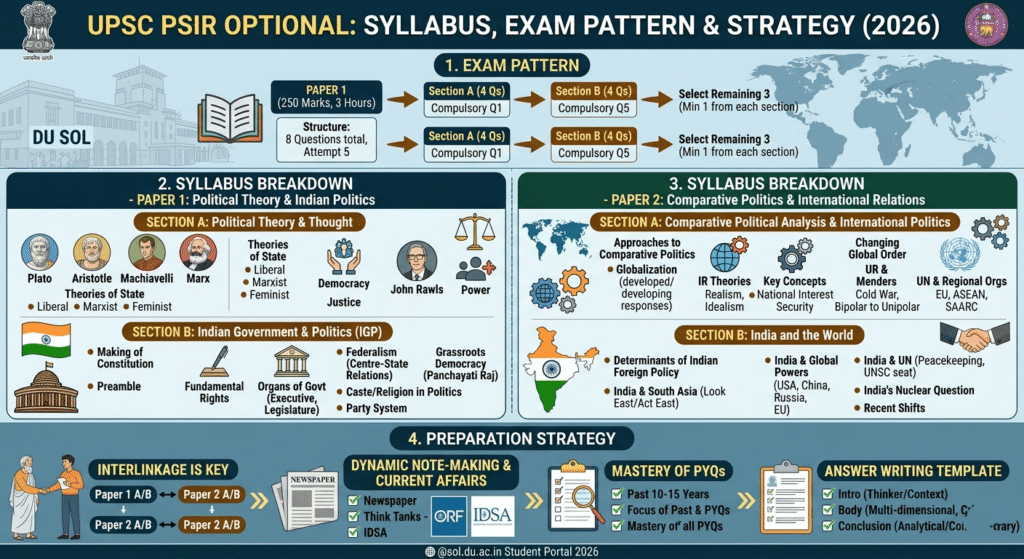
Complete Structure of PSIR Optional
The PSIR syllabus is divided into two papers:
| Paper | Topics | Marks |
|---|---|---|
| Paper 1 | Political Theory & Indian Politics | 250 |
| Paper 2 | Comparative Politics & International Relations | 250 |
Paper 1 mainly focuses on:
- Political thinkers
- Ideologies
- Indian Constitution
- Indian political system
- Governance and democracy
Paper 2 deals with:
- International relations
- Global politics
- Comparative politics
- India’s foreign policy
- International organizations
According to recent UPSC preparation resources, PSIR is considered one of the most “current-affairs integrated” optionals because topics from newspapers directly help in answers.
UPSC PSIR Optional Syllabus for Paper 1
Political Theory and Indian Politics:
- Political Theory: meaning and approaches.
- Theories of state: Liberal, Neo-liberal, Marxist, Pluralist, Post-colonial, and Feminist.
- Justice: Conceptions of justice with special reference to Rawl’s theory of justice and its communitarian critiques.
- Equality: Social, political, and economic; the relationship between equality and freedom; Affirmative action.
- Rights: Meaning and theories; different kinds of rights; Concept of Human Rights.
- Democracy: Classical and contemporary theories; different models of democracy – representative, participatory and deliberative.
- Concept of power: hegemony, ideology, and legitimacy.
- Political Ideologies: Liberalism, Socialism, Marxism, Fascism, Gandhism, and Feminism.
- Indian Political Thought: Dharmashastra, Arthashastra, and Buddhist Traditions; Sir Syed Ahmed Khan, Sri Aurobindo, M. K. Gandhi, B. R. Ambedkar, M. N. Roy.
- Western Political Thought: Plato, Aristotle, Machiavelli, Hobbes, Locke, John S. Mill, Marx, Gramsci, Hannah Arendt.
Indian Government and Politics
- Indian Nationalism:
- Political Strategies of India’s Freedom Struggle: Constitutionalism to mass Satyagraha, Noncooperation, Civil Disobedience; Militant and Revolutionary Movements, Peasant and Workers Movements.
- Perspectives on Indian National Movement; Liberal, Socialist, and Marxist; Radical Humanist and Dalit.
- Making of the Indian Constitution: Legacies of British rule; different social and political perspectives.
- Salient Features of the Indian Constitution: The Preamble, Fundamental Rights and Duties, Directive Principles; Parliamentary System and Amendment Procedures; Judicial Review and Basic Structure doctrine.
- (a) Principal Organs of the Union Government: Envisaged role and actual working of the Executive, Legislature, and Supreme Court.
(b) Principal Organs of the State Government: Envisaged role and actual working of the Executive, Legislature, and High Courts. - Grassroots Democracy: Panchayati Raj and Municipal Government; Significance of 73rd and 74th Amendments; Grassroot movements.
- Statutory Institutions/Commissions: Election Commission, Comptroller and Auditor General, Finance Commission, Union Public Service Commission, National Commission for Scheduled Castes, National Commission for Scheduled Tribes, National Commission for Women; National Human Rights Commission, National Commission for Minorities, National Backward Classes Commission.
- Federalism: Constitutional provisions; changing nature of center-state relations; integrationist tendencies and regional aspirations; inter-state disputes.
- Planning and Economic Development: Nehruvian and Gandhian perspectives; Role of planning and public sector; Green Revolution, land reforms and agrarian relations; liberalization and economic reforms.
- Caste, Religion, and Ethnicity in Indian Politics.
- Party System: National and regional political parties, ideological and social bases of parties; Patterns of coalition politics; Pressure groups, trends in electoral behavior; changing socio-economic profile of Legislators.
- Social Movement: Civil liberties and human rights movements; women’s movements; environmentalist movements.
UPSC PSIR Optional Syllabus for Paper 2
Comparative Politics & International Relations
- Comparative Political Analysis and International Politics:
Comparative Politics: Nature and major approaches; Political economy and political sociology perspectives; Limitations of the comparative method. - State in Comparative Perspective: Characteristics and changing nature of the State in capitalist and socialist economies, and advanced industrial and developing societies.
- Politics of Representation and Participation: Political parties, pressure groups and social movements in advanced industrial and developing societies.
- Globalisation: Responses from developed and developing societies.
- Approaches to the Study of International Relations: Idealist, Realist, Marxist, Functionalist, and Systems theory.
- Key Concepts in International Relations:
a. National interest, security and power
b. Balance of power and deterrence c. Transnational actors and collective security
d. World capitalist economy and globalisation. - Changing International Political Order:
- Rise of superpowers; Strategic and ideological Bipolarity, arms race and cold war; Nuclear threat;
- Non-aligned movement: Aims and achievements.
- Collapse of the Soviet Union; Unipolarity and American hegemony; Relevance of non-alignment in the contemporary world.
- Evolution of the International Economic System:
a. From Bretton Woods to WTO
b. Socialist economies and the CMEA (Council for Mutual Economic Assistance)
c. Third World demand for new international economic order
d. Globalisation of the world economy. - United Nations: Envisaged role and actual record; Specialized UN agencies—aims and functioning; the need for UN reforms.
- Regionalisation of World Politics: EU, ASEAN, APEC, AARC, NAFTA.
- Contemporary Global Concerns: Democracy, human rights, environment, gender justice terrorism, nuclear proliferation.
India and the World
- Indian Foreign Policy: Determinants of foreign policy; the institutions of policy-making; continuity and change.
- India’s Contribution to the Non-Alignment Movement Different phases; Current role.
- India and South Asia:
- Regional Co-operation: SAARC-past performance and future prospects.
- South Asia as a Free Trade Area.
- India’s “Look East” policy.
- Impediments to regional co-operation: River water disputes; illegal cross-border migration; Ethnic conflicts and insurgencies; Border disputes.
- India and the Global South: Relations with Africa and Latin America; Leadership role in the demand for NIEO and WTO negotiations.
- India and the Global Centres of Power: USA, EU, Japan, China and Russia.
- India and the UN System: Role in UN Peace-keeping; Demand for Permanent Seat in the Security Council.
- India and the Nuclear Question: Changing perceptions and policy.
- Recent developments in Indian Foreign Policy: India’s position on the recent crises in Afghanistan, Iraq, and West Asia, growing relations with US and Israel; Vision of a new world order.
How to Approach UPSC PSIR Optional : Strategy
- Build conceptual clarity: Start with core political theories and key thinkers.
- Connect theory to current events: Apply PSIR concepts to modern examples, especially in international relations and Indian politics.
- Integrate with GS: Study PSIR topics alongside General Studies subjects (e.g. Constitution, IR) to reinforce learning.
- Study Plan: Cover static topics (theory, Indian politics) first, then focus on dynamic content (current affairs, international issues). Allocate specific time each week to each section.
- Practice answer writing: Regularly write answers and essays. Use UPSC past questions to guide practice.
- Revision & notes: Make concise notes or mind-maps for each topic. Revise regularly with summaries.
- Avoid mistakes: Always use examples and case studies. Don’t ignore current affairs. Keep answers focused and time-bound.